


Page 124 - Winter Issue
P. 124
Could you share how you approach working with negative space, and what role it plays?
             In  my  work,  negative  space  embodies  the  hidden  power  of  "non-being"—a  space  that  is  empty  yet  brimming  with
             potential. By employing negative space, I draw attention to the often-overlooked vitality within the void. It serves not only
             as a visual element but also as a philosophical expression, allowing viewers to explore the energy and transformation
             that lie within the unseen spaces of each piece.
             Your artist statement speaks about the cyclical process between "non-being" and "being." How does this
             cycle influence the physical techniques you use, such as forming and firing clay?
             The cyclical process of "non-being" and "being" is directly reflected in my techniques. The transformation of clay—from
             soft and malleable to firm and permanent—parallels the journey from "non-being" to "being." During firing, I embrace
             the  fluid  and  unpredictable  nature  of  glazes  to  capture  the  organic  shift  from  "non-being"  to  "being."  This
             unpredictability  mirrors  the  Daoist  view  of  natural  transformation  and  cycles,  where  change  is  both  inevitable  and
             dynamic.
             How has your doctoral research at the University of Sunderland contributed to your practice?
             My doctoral research at the University of Sunderland has provided a strong theoretical and practical foundation for
             exploring "non-being." Studying both Daoist thought and Western art perspectives has deepened my understanding of
             how "non-being" can be expressed across cultural contexts. This interdisciplinary approach has enriched my work, giving
             me the confidence to articulate the essence of "non-being" through a cross-cultural lens.
             How do you balance form and formlessness, presence and absence, in your ceramic works?
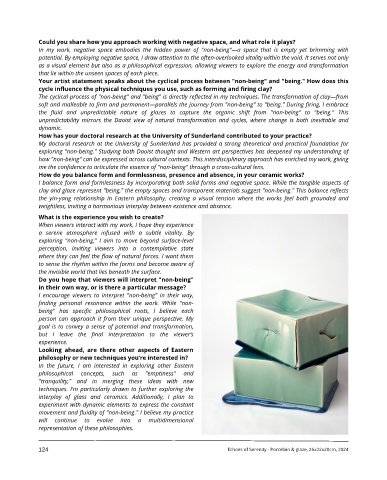
             I balance form and formlessness by incorporating both solid forms and negative space. While the tangible aspects of
             clay and glaze represent "being," the empty spaces and transparent materials suggest "non-being." This balance reflects
             the  yin-yang  relationship  in  Eastern  philosophy,  creating  a  visual  tension  where  the  works  feel  both  grounded  and
             weightless, inviting a harmonious interplay between existence and absence.
             What is the experience you wish to create?
             When viewers interact with my work, I hope they experience
             a  serene  atmosphere  infused  with  a  subtle  vitality.  By
             exploring  "non-being,"  I  aim  to  move  beyond  surface-level
             perception,  inviting  viewers  into  a  contemplative  state
             where they can feel the flow of natural forces. I want them
             to sense the rhythm within the forms and become aware of
             the invisible world that lies beneath the surface.
             Do you hope that viewers will interpret "non-being"
             in their own way, or is there a particular message?
             I  encourage  viewers  to  interpret  "non-being"  in  their  way,
             finding  personal  resonance  within  the  work.  While  "non-
             being"  has  specific  philosophical  roots,  I  believe  each
             person can approach it from their unique perspective. My
             goal is to convey a sense of potential and transformation,
             but  I  leave  the  final  interpretation  to  the  viewer’s
             experience.
             Looking  ahead,  are  there  other  aspects  of  Eastern
             philosophy or new techniques you’re interested in?
             In  the  future,  I  am  interested  in  exploring  other  Eastern
             philosophical   concepts,   such   as   "emptiness"   and
             "tranquility,"  and  in  merging  these  ideas  with  new
             techniques. I’m particularly drawn to further exploring the
             interplay  of  glass  and  ceramics.  Additionally,  I  plan  to
             experiment with dynamic elements to express the constant
             movement and fluidity of "non-being." I believe my practice
             will   continue   to   evolve   into   a   multidimensional
             representation of these philosophies.


             124                                                       Echoes of Serenity - Porcelain & glaze, 26x22x20cm, 2024

